
Weekly Session by Helder Guimaraes ( 3 Sessions , Instant Download )
Session 1:
This video introduces a weekly segment aimed at sharing insights, techniques, and routines related to magic. The first tip focuses on the value of reading old magic books to inspire creativity and deepen understanding. The presenter uses the “Encyclopedia of Card Tricks” by Jean Hugard as a prime example, highlighting how its brief descriptions encourage magicians to use their imagination and add personal details to classic effects.
Core Concept: Reading Old Magic Books
- Old magic books feature very concise descriptions, which serve as a creative springboard rather than detailed instructions.
- Such brevity allows magicians to explore, personalize, and improve upon existing tricks.
- The presenter emphasizes that this approach aids in developing a unique style and solving subtle performance issues.
Detailed Explanation of the Card Trick: A Reversed Card (Louis A, 1936)
Effect Overview
- A spectator freely selects a card from the deck.
- This card is returned to the middle of the deck.
- The deck is shuffled.
- At the end, the selected card appears reversed (face down) in the middle of the deck, while all other cards are face up.
Method and Handling
- The deck is prepared so that half the deck is face down and half is face up.
- A slight bend is applied to the deck, creating a small gap at the back to facilitate cutting.
- The spectator selects a card from the top half (face up) and returns it to the bottom half (face down).
- When the bottom half is secretly flipped, the selected card becomes the only reversed card in the deck.
- Pressing the front of the deck closes the gap, making the deck appear square and normal.
Key Performance Tips
- Instead of immediately separating the deck halves on the table (as per the original description), the presenter suggests starting a riffle shuffle immediately.
- Benefits of shuffling first:
- Prevents spectators from comparing the two halves of the deck.
- The secret card turn occurs mid-shuffle, which misdirects attention.
- Spectators’ memory favors the half without trickery, enhancing deception.
- The bent cards behave like long and short cards during a dribble, preventing the reversed card from flashing.
- Caution is advised when dribbling: cards must fall one on top of the other to avoid revealing the reversed card.
Psychological and Practical Insights
- The final image spectators remember is the natural half of the deck, not the manipulated one.
- The subtle extra turn during shuffling acts as effective misdirection.
- The method allows for a clean, casual display of the deck as apparently all cards are face down.
- The spectator can place their finger on the deck at the climax, reinforcing the illusion of fairness and transparency.
Presentation and Impact
- The revealed reversed card in the middle of the deck creates a strong impact on the audience.
- The routine is flexible and can be adapted with various scripts or endings:
- Asking the spectator to magically turn the card face up.
- Asking them to name the card, which then appears reversed in the deck.
Key Insights
- Short, vague descriptions in old magic books are fertile ground for creativity and personalization.
- The A Reversed Card trick combines classic principles with subtle innovations (deck bending, mid-shuffle turn).
- Misdirection through timing and handling is critical to maintaining the illusion.
- Personalizing an effect by solving minor performance details enhances uniqueness and style.
This video effectively demonstrates how studying and adapting old magic literature can lead to improved, personalized magic performances. The presenter’s critique and refinement of the A Reversed Card effect showcase the importance of subtle handling and psychological misdirection in card magic.
Session 2:
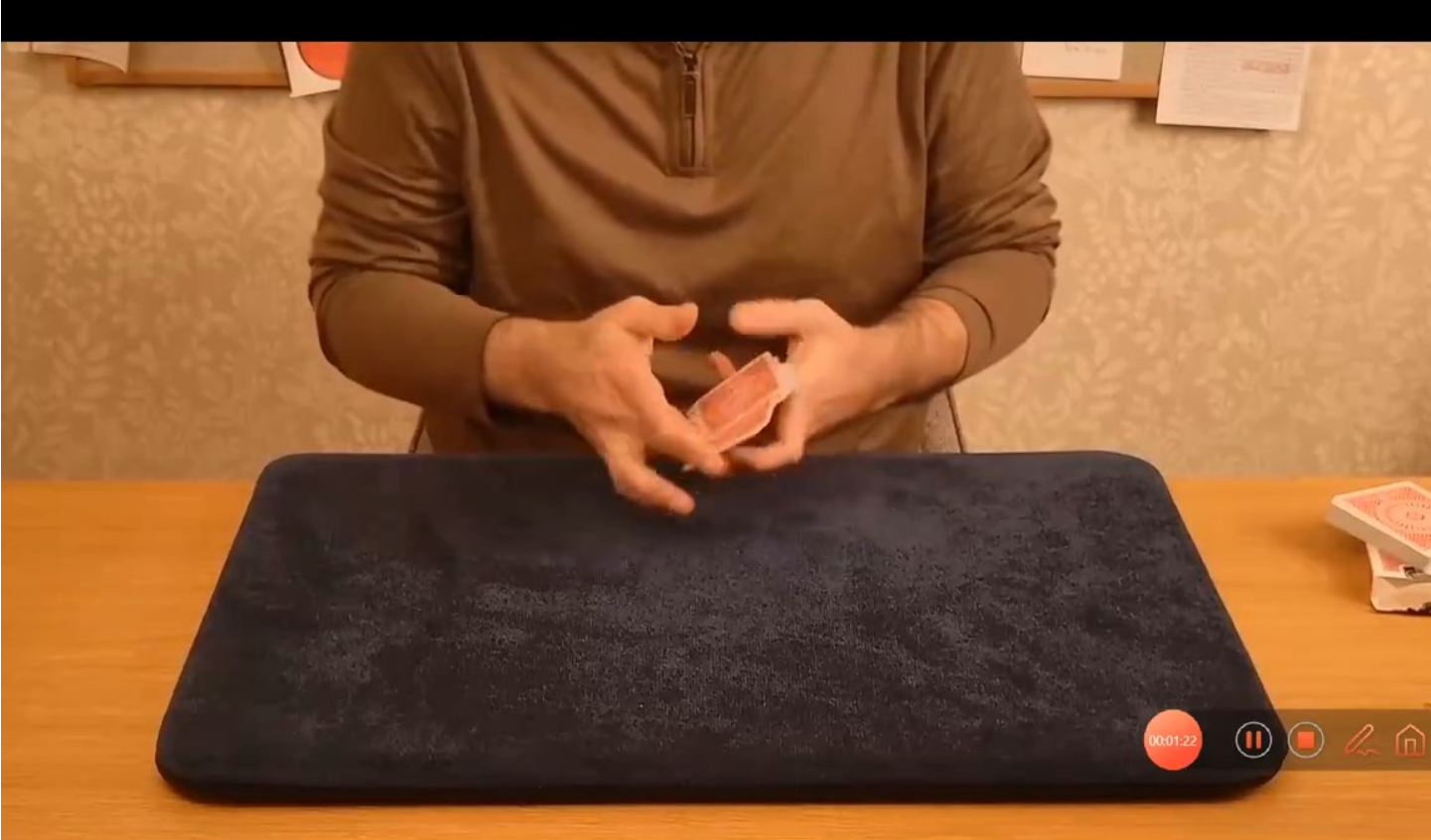
This video session provides an in-depth exploration of the overhand shuffle control, a card control technique often overlooked by magicians. The presenter breaks down the mechanics, choreography, and psychological aspects behind this method, highlighting its versatility and deceptive potential.
Core Concepts and Technique Breakdown
- Overhand Shuffle Control: A technique to control one or a small group of cards, typically preserving the top card’s position after shuffling.
- The control is achieved by:
- Taking a small packet of cards in the left hand.
- Creating a jog (a slight offset) with one card.
- Shuffling the remaining cards on top while maintaining a break under the jogged card.
- Dropping the original top packet on top after the shuffle, thus controlling the card(s).
Detailed Observations on Execution and Visual Impact
- Beginners tend to create a large jog (offset) to ensure control, but this looks unnatural and visually suspicious compared to a regular shuffle, which has no jog.
- A subtle jog is more deceptive but harder to perform, especially when talking and not looking at the cards.
- Multiple jogs (going back and forth) can mask the initial jog but might appear unnatural and are not the best cover-up.
- The technique requires two shuffles to complete control, which can create a feeling of an action being done and undone, potentially raising suspicion.
- Gestures such as tapping during the shuffle can imply that the shuffle is finished, which can conflict with subsequent actions if the control is repeated.
Improved Choreography Proposal
The presenter suggests a refined choreography for the overhand shuffle control that emphasizes naturalness and psychological believability:
- Use a side jog instead of an in jog, which mimics the natural mechanics of a real shuffle more closely.
- The side jog involves taking groups of cards rather than individual cards, producing a more authentic shuffle sound and appearance.
- After shuffling, perform a cut instead of a second shuffle to complete the control.
- This cut feels natural and distinct from the shuffle, avoiding the impression of undoing previous actions.
- The cut is executed with a double cut, cutting a small packet first, then cutting at the break, and finally dropping the original top packet on top. This creates a psychological barrier and deepens the deception. |
Applications and Variations
- The side jog shuffle can be used to control cards even when spreading the deck, as the larger gap created by the jog reveals the position of the controlled card.
- Example application:
- After shuffling, spread cards to reveal a “wrong” card.
- Break one card beyond the controlled card.
- Use false display and pickup moves to place the controlled card back on top.
- The technique allows for flexible card positioning, including controlling a card to the top, bottom, or a specific position by adjusting the number of cards placed on top.
- The presenter emphasizes the importance of knowing the card’s position throughout, enabling complex controls within apparent chaos.
- This chaotic control style is versatile but not preferred by everyone; however, it offers many creative possibilities.
Key Insights and Conclusions
- The overhand shuffle control is highly versatile and underused, with significant potential for deception in magic performances.
- Successful execution relies heavily on natural choreography and psychology, avoiding unnatural gestures and timing issues.
- The side jog with a cut is a superior method to the traditional double shuffle approach, producing a more convincing illusion of randomness.
- subtle handling of the break and cut enhances the illusion of fairness and randomness.
- The technique encourages personal experimentation and adaptation, inviting magicians to develop their own variations.
- Overall, the presenter advocates for mastery of subtlety, naturalness, and psychological misdirection to maximize the impact of this control.
Session 3:
The video presents an in-depth exploration of the Charlier shuffle, an old false shuffle technique used in card magic. The presenter dissects the technique from both a performative and technical perspective, offering insights into its applications, variations, and underlying mechanics.
Core Concepts and Key Insights
- Charlier shuffle basics:
- It is a false shuffle that looks like a shuffle but effectively acts as a simple cut of the deck.
- The shuffle involves taking groups of cards alternately from the top or bottom of one pile and placing them on the other.
- No matter how many times or where the shuffle stops, the deck remains either in order or one cut away from the original order.
- Performative aspect:
- The Charlier shuffle is a performative technique that manipulates audience emotions.
- The audience perceives a lot of mixing and disorder, but the deck’s order is preserved.
- This emotional engagement is more impactful than a simple cut because it tells a bigger story of apparent card mixing without the actual change in order.
- Technical perspective:
- The shuffle can be broken down into discrete moments, offering flexibility in choreography.
- At any point during the shuffle, you have two packets, and it doesn’t matter which packet goes on top; the deck remains just one cut away from the original order.
- This flexibility allows visual variations to create the illusion of mixing while preserving order.
- Variations introduced:
- Revolving Charlier Shuffle:
- Involves turning cards over and dropping groups on the table.
- Uses table drops and rotations to vary the choreography while maintaining the one-cut-away property.
- This variation feels looser and more casual, adding depth to performance.
- Multi-group variation inspired by Lennart Green:
- Deals cards into multiple small piles on the table (usually 2-3 cards each).
- Sequentially recombines piles to maintain the original order.
- Utilizes visible cues (like a jogged card) to identify the cut point, enabling restoration of order after the illusion of shuffling.
- Use of table:
- The shuffle can start with cards spread on the table.
- Cards are picked from top and bottom piles and recombined to simulate mixing.
- Despite apparent chaos, the deck remains one cut away from its original order.
- Importance of the cut point:
- The entire technique hinges on knowing where to cut the deck to restore the original order.
- A jogged card or marked position aids in identifying this cut point.
- Multiple shuffles can be done, and the correct cut will restore the deck.
Additional Key Points
- The Charlier shuffle is always one cut away from restoring the original order, regardless of how many times it is performed.
- The use of visual interference and choreography changes enhances the illusion without compromising the technique.
- Knowledge of where to cut is critical and can be tracked using subtle markers such as a jogged card.
- Exploring and personalizing the choreography of the Charlier shuffle adds color and depth to a performance and prevents repetitiveness.
- The method exemplifies how breaking down a known technique can lead to creative adaptations that fit different performance contexts.
Conclusions
- The Charlier Shuffle is more than a mechanical false shuffle; it is a performative tool that shapes audience perception by mixing appearance and reality.
- Its technical robustness and flexibility allow performers to innovate and tailor the shuffle to their style and show needs.
- Understanding the underlying principles—especially the two-packet system and cut recovery—enables magicians to confidently manipulate the shuffle’s choreography without losing control over the deck order.
- The presenter encourages magicians to explore and reinterpret existing techniques like the Charlier shuffle to keep their performances fresh and impactful.




by-lukas-200x200-1-1.png)